
South Indian · Breakfast, Lunch
Masala dosa with sambar
Potato-filled dosa with lentil-vegetable stew
- Total time19 hrstart to table
- Hands on1 hr 30 minactual work
- EffortInvolved
- Serves4as written
- Per serving~680 kcalapprox.
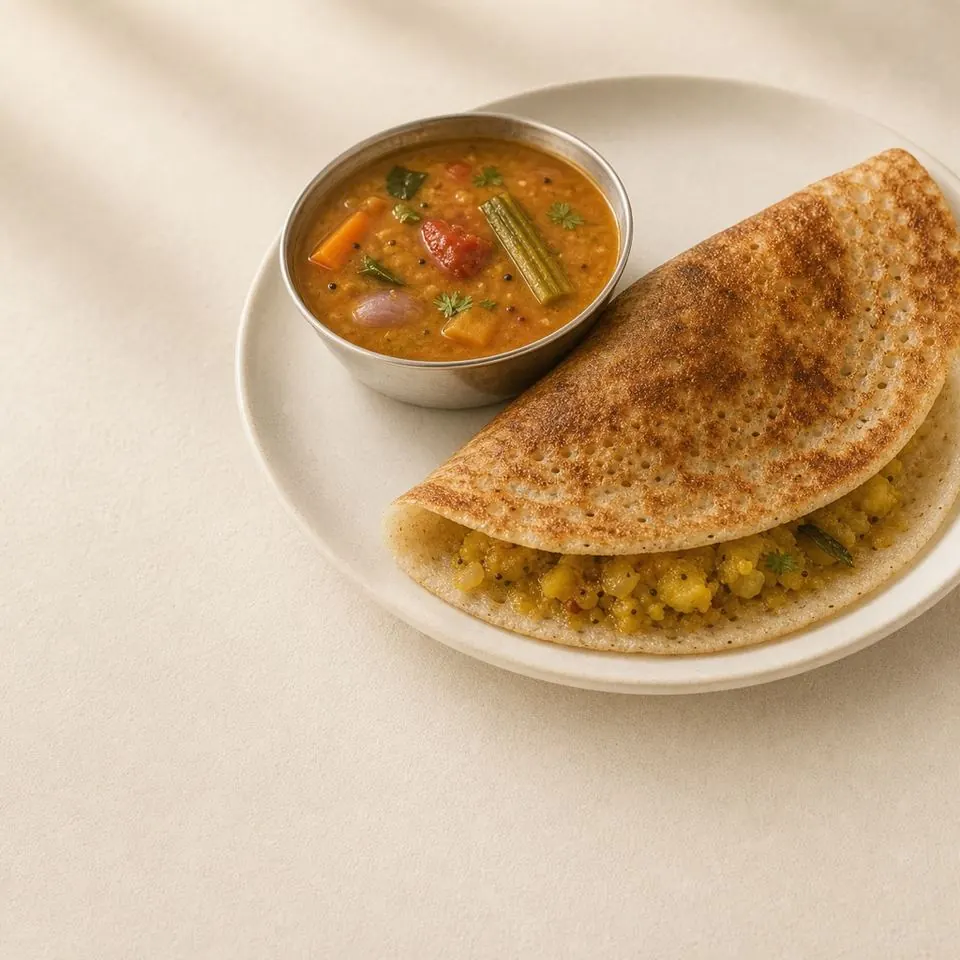
A complete South Indian tiffin plate: eight crisp fermented rice-and-urad dosas, a mustard-and-curry-leaf potato masala, and a pourable vegetable toor-dal sambar. The batter is a day-ahead project; the filling and sambar cook while it comes to room temperature, then each dosa is spread, browned and filled to order.
Method
-
Start 18 hours before serving. Rinse 300 g idli rice (parboiled rice) until the water is mostly clear; soak it with 1 tsp fenugreek seeds. In a second bowl rinse and soak 75 g whole skinned urad dal. Split 2000 ml water for soaking rice and urad between the two bowls so the grains are covered by at least 5 cm. Soak for 4 to 6 hours, then drain completely; this soaking water is not the measured grinding water.
Done when: Rice and urad are fully hydrated and completely drained after the minimum soak.
-
Using the water for dosa batter a little at a time, grind whole skinned urad dal first until very smooth, pale and fluffy; transfer to the large fermentation bowl. Grind idli rice (parboiled rice) and fenugreek seeds to a smooth batter with a faint fine-grain feel. Mix both batters vigorously by hand for 2 minutes. Use only enough of the measured 500 ml to make a thick, pourable batter; reserve any remainder for thinning after fermentation.
Done when: The combined batter is thick, pourable and aerated without coarse urad pieces.
-
Mix in 1 tsp fine salt for dosa batter. Mark the batter level, cover loosely and leave in a reliably warm, draught-free place for 8 to 12 hours; the fermentation bowl must stay below half full so the batter can rise safely. Fermentation is ready when the batter has noticeably risen, looks aerated across the surface and smells cleanly sour; cool kitchens may show less rise, so use all three signs. If it has not changed, give it more warm time rather than cooking dense dosas; discard batter with pink, orange or fuzzy growth or a rotten smell.
Done when: Batter is visibly risen, aerated and cleanly sour with no spoilage signs.
-
Rinse 100 g toor dal. Put it in the pressure cooker with 1/4 tsp ground turmeric for sambar and 300 ml taken from 900 ml water for sambar. Lock the lid, bring to pressure over medium-high heat, then cook at steady pressure for 10 minutes. Turn off the heat and let pressure release naturally before opening; whisk the dal smooth.
Done when: Dal grains collapse completely when pressed and whisk into a smooth puree.
-
Meanwhile, put 500 g potatoes and 1500 ml water for boiling potatoes in the sambar pot, bring to a boil, then simmer until a knife enters the centre with little resistance, 18 to 22 minutes. Drain the potato water completely, cool the potatoes just enough to handle, peel if desired and break into rough 2 cm chunks. Rinse the pot for the sambar.
Done when: A knife slides through the thickest potato with little resistance, but the potato still holds together when drained.
-
Soak 20 g seedless tamarind in 100 ml hot water taken from the remaining water for sambar for 15 minutes, squeeze well and strain. In the sambar pot combine the tamarind water, all remaining water for sambar, 100 g carrots, 150 g fresh drumstick pods, 150 g tomatoes, 100 g small onions (shallots), 2 tbsp sambar powder, 1 tsp jaggery if using, and 1 1/2 tsp fine salt for sambar. Cover and simmer 10 to 12 minutes, until the carrot and drumstick are tender. Stir in the mashed toor dal and simmer uncovered 8 minutes; add up to 200 ml hot water for adjusting sambar only if needed for a pourable, spoon-coating stew.
Done when: Carrot is easily pierced, drumstick flesh is soft, and the dal stays suspended in a pourable stew rather than settling as watery broth.
-
Heat 1 tbsp groundnut oil for sambar tempering in a small area of the clean masala pan over medium heat. Add 1 tsp black mustard seeds for sambar tempering; when it crackles, add 2 piece dried red chillies, 10 piece fresh curry leaves for sambar tempering and 1 pinch asafoetida. Cover briefly against splutter, cook 30 seconds without blackening the spices, then pour the tempering into the sambar. Stir through 15 g fresh coriander leaves, cover and keep warm on the lowest heat.
Done when: The sambar tempering is aromatic, the mustard has crackled and the curry leaves are crisp-edged without burnt spices.
-
Heat 1 tbsp groundnut oil for potato masala in the masala pan over medium heat. Add 1 tsp black mustard seeds; when it crackles add 2 tsp chana dal and cook until pale gold. Add 12 piece fresh curry leaves for potato masala, 2 piece chopped green chillies, 15 g grated fresh ginger, and 200 g thinly sliced yellow onions; cook 6 to 8 minutes until soft but not browned. Stir in 1/2 tsp ground turmeric for potato masala, 1 tsp fine salt for potato masala, the cooked potatoes, and 80 ml water for potato masala. Fold and lightly crush for 3 minutes, then turn off the heat and squeeze over 1 piece lemon.
Done when: Onions are translucent, chana dal is crisp rather than raw, and the filling is moist and spoonable with distinct potato pieces and no free water.
-
Stir the fermented batter gently; thin it with some reserved water for dosa batter only until it pours in a continuous ribbon. Heat the dry dosa tawa over medium-high, then reduce to medium. For each of 8 dosas, wipe the tawa with a lightly oiled cloth, pour about 120 ml batter in the centre and immediately spiral outward with the back of the ladle to about 24 cm. Drizzle a share of 2 tbsp groundnut oil for dosas around the edge. Cook 2 to 3 minutes without flipping, until the surface is dry, the underside is deep golden and the edge releases. If batter clumps before spreading, cool the tawa briefly; if it stays pale and rubbery, heat it longer before the next dosa.
Done when: Underside is evenly deep golden and crisp, top has no wet batter, and the edge lifts cleanly with a thin spatula.
-
Place one eighth of the potatoes masala across the centre of each crisp dosa, fold without crushing, and serve immediately: 2 dosas per person with one quarter of the hot toor dal sambar on the side. Keep cooked dosas in a single layer or serve each batch straight from the tawa; stacking traps steam and removes the crisp texture.
Done when: Eight crisp dosas are filled without crushing and four servings each have two dosas plus one quarter of the hot sambar.
Or have it read to you
In the app these same steps are read aloud one at a time, hands-free, with the timers running — and the cook guide speaks eleven Indian languages, so whoever is at the stove can follow along without reading English.
- English
- Hindi
- Tamil
- Telugu
- Bengali
- Marathi
- Kannada
- Malayalam
- Gujarati
- Punjabi
- Odia
Good to know
- Diet
- Vegetarian
- Eaten at
- Breakfast, Lunch
- Nutrition, per serving
- ~680 kcal · 18 g protein · 115 g carbs · 17 g fat (approx.)
- Keeps
- 3 days in the fridge